
RBX1 Binder Design — Summary Report
Target
Human RBX1 (UniProt P62877) — catalytic RING-H2 subunit of Cullin-RING E3 ubiquitin ligase complexes. Directs ubiquitination of ~20% of cellular proteins; dysregulated in cancer. Primary epitope: E2-binding surface on the RING-H2 domain (residues 45–90).
Design Campaign
100 sequences submitted across three parallel strategies, with a post-competition collaboration with Protein Design for Africa (PDFA) — a student group from Nigeria who applied BindCraft + BoltzGen on IDR-truncated RBX1.
| Strategy | Tool | Sequences | Boltz-2 iptm range |
|---|---|---|---|
| De novo backbone | RFdiffusion + ProteinMPNN | 47 | 0.710–0.910 |
| GLMN scaffold redesign (PDB 4F52) | ProteinMPNN | 46 | 0.846–0.887 |
| CUL1 WHB scaffold (PDB 1LDJ) | ProteinMPNN | 7 | 0.41–0.761 |
Experimental Results — BLI (Adaptyv Foundry)
Affinity characterisation by bio-layer interferometry · 3 replicates · 5 antigen concentrations (0–1000 nM).
| Design | Source | Boltz-2 iptm | KD | Result |
|---|---|---|---|---|
PDFA_Cterm_s252595_mpnn10 | PDFA | 0.918 | 185 nM | Binder |
PDFA_NtermSolMPNN2_s565603_mpnn6 | PDFA | 0.927 | — | No binding |
PDFA_NtermSolMPNN_s92146_mpnn3 | PDFA | 0.910 | — | No binding |
GLMN_T0.1_s11 | Steamulater | 0.887 | — | No binding |
GLMN_T0.3_s8 | Steamulater | 0.878 | — | No binding |
RFD_167_best | Steamulater | 0.848 | — | No binding |
CUL1_WHB_T0.2_s16 | Steamulater | 0.761 | — | No binding |
PDFA_Cterm_s252595_mpnn10 — replicate kinetics
| Replicate | KD | kon (M⁻¹s⁻¹) | koff (s⁻¹) |
|---|---|---|---|
| 1 | 144 nM | 81,910 | 1.18×10⁻² |
| 2 | 126 nM | 50,767 | 6.38×10⁻³ |
| 3 | 286 nM | 31,098 | 8.89×10⁻³ |
| Mean | 185 nM | 54,591 | 9.03×10⁻³ |
KD log std = 0.156 — consistent signal across all 3 replicates.
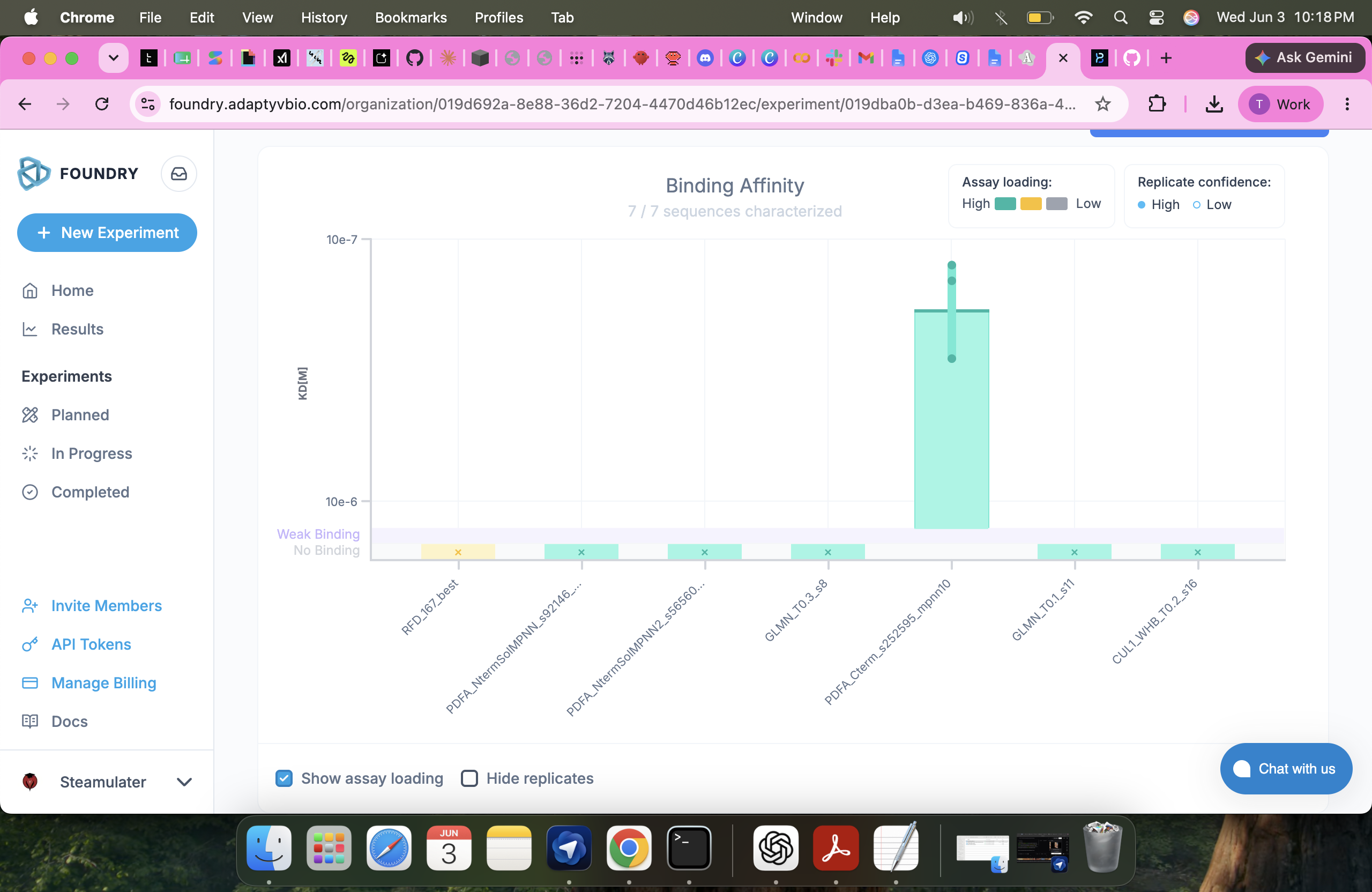
Adaptyv Foundry dashboard — binding affinity with assay loading colour overlay
Context: Full Competition (322 entries)
Only 10 designs across all 322 entries have a measured KD. Our binder at 185 nM ranks 5th — right at the median of confirmed binders.
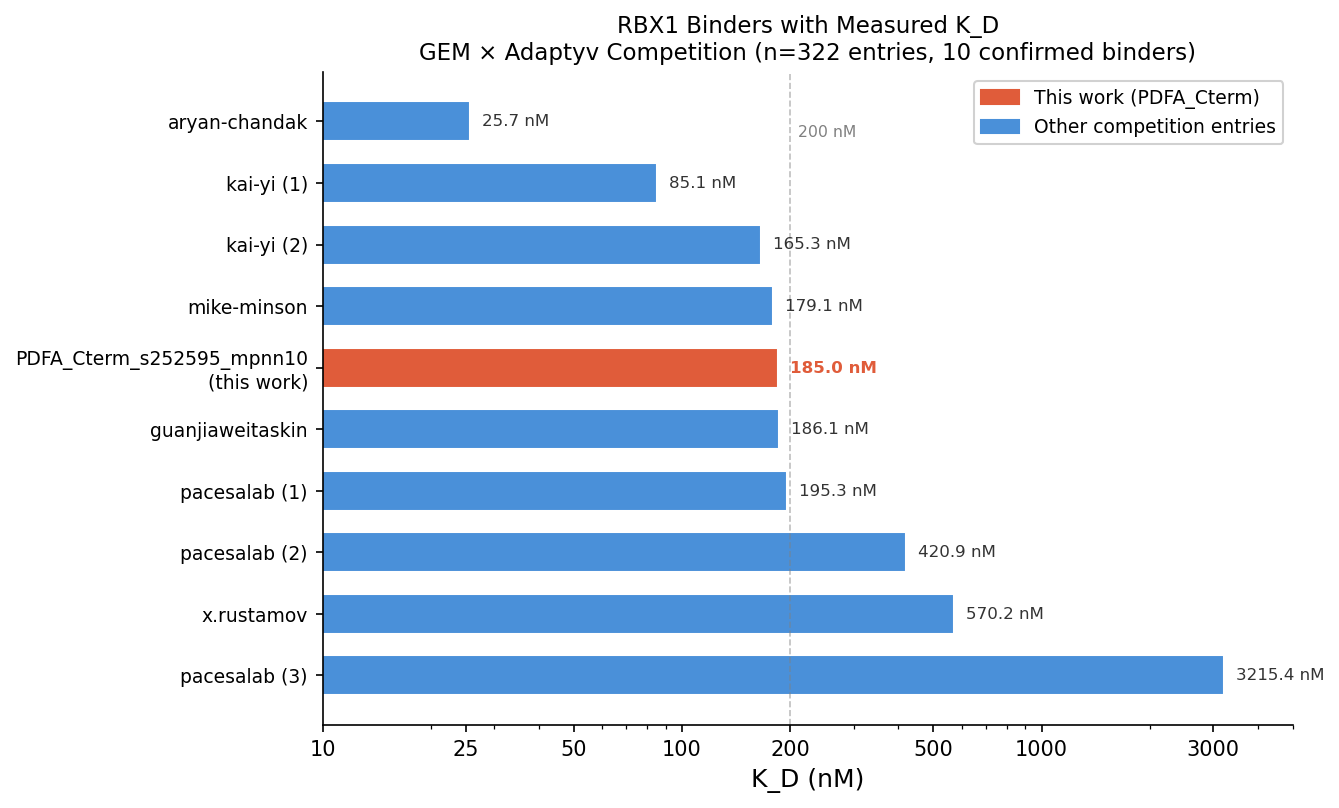
KD of all 10 confirmed binders. Competition values by SPR; ours by BLI.
Key Observations
- C-terminal RBX1 surface is the productive epitope. The PDFA C-terminal binder is the sole hit. Both PDFA N-terminal designs — ranked #1 and #3 by Boltz-2 iptm — showed no binding.
- Boltz-2 iptm does not predict outcome within a high-scoring cohort. The highest-iptm design (0.927) failed; the binder (0.918) ranked 2nd computationally.
- GLMN scaffold redesign did not translate. Strong scores and near-native ring RMSD (<1 Å) did not produce binding — large flat interfaces may require near-native sequence identity.
- De novo miniprotein (70 aa) did not bind. Lowest peak BLI response suggests poor expression or folding under assay conditions.
References
Methods
| Tool | Citation |
|---|---|
| RFdiffusion | Watson J.L. et al. "De novo design of protein structure and function with RFdiffusion." Nature 620, 1089–1100 (2023). doi:10.1038/s41586-023-06415-8 |
| ProteinMPNN | Dauparas J. et al. "Robust deep learning–based protein sequence design using ProteinMPNN." Science 378, 49–56 (2022). doi:10.1126/science.add2187 |
| Boltz-2 | Wohlwend J. et al. "Boltz-1: Democratizing Biomolecular Interaction Modeling." bioRxiv (2024). doi:10.1101/2024.11.19.624167 |
| BindCraft | Pacesa M. et al. "BindCraft: one-shot protein binder design using AlphaFold2." Nature (2025). doi:10.1038/s41586-025-08741-7 |
Data & Lab Records
| Document | Location |
|---|---|
| Full lab notebook (Entries 001–017) | lab_notebook.md — steamulater/adaptyv-rbx1-binder-design |
| Submission writeup | submission_writeup.md |
| PDFA method writeup | students_submission/Protein design for africa, method write up.pdf |
| Boltz-2 PDFA standardisation notebook | students_submission/boltz_pdfa_validation.ipynb |
| BLI raw data package | Adaptyv Foundry experiment SUL-001-002 |
| Proteinbase RBX1 competition dataset | proteinbase.com — GEM × Adaptyv RBX1 results |
References
Methods
| Tool | Citation |
|---|---|
| RFdiffusion | Watson J.L. et al. "De novo design of protein structure and function with RFdiffusion." Nature 620, 1089–1100 (2023). doi:10.1038/s41586-023-06415-8 |
| ProteinMPNN | Dauparas J. et al. "Robust deep learning–based protein sequence design using ProteinMPNN." Science 378, 49–56 (2022). doi:10.1126/science.add2187 |
| Boltz-2 | Wohlwend J. et al. "Boltz-1: Democratizing Biomolecular Interaction Modeling." bioRxiv (2024). doi:10.1101/2024.11.19.624167 |
| BindCraft | Pacesa M. et al. "BindCraft: one-shot protein binder design using AlphaFold2." Nature (2025). doi:10.1038/s41586-025-08741-7 |
Data & Lab Records
| Document | Location |
|---|---|
| Full lab notebook (Entries 001–017) | lab_notebook.md — steamulater/adaptyv-rbx1-binder-design |
| Submission writeup | submission_writeup.md |
| PDFA method writeup | students_submission/Protein design for africa, method write up.pdf |
| Boltz-2 PDFA standardisation notebook | students_submission/boltz_pdfa_validation.ipynb |
| BLI raw data package | Adaptyv Foundry experiment SUL-001-002 |
| Proteinbase RBX1 competition dataset | proteinbase.com — GEM × Adaptyv RBX1 results |